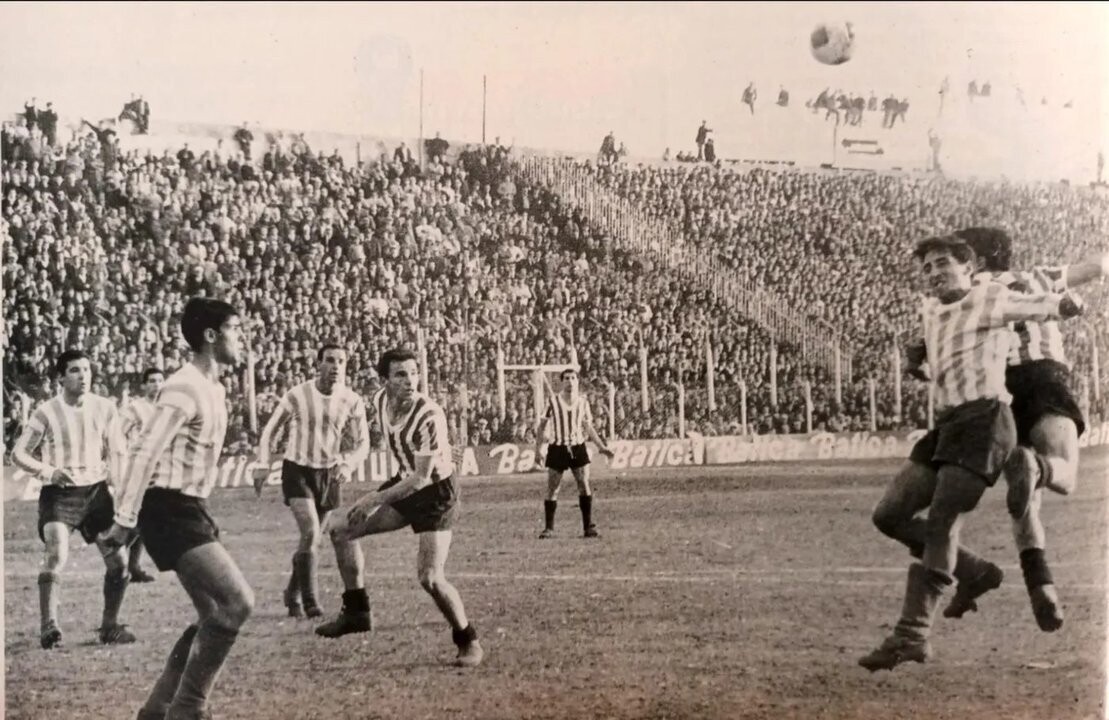
In 1967, the Metropolitano was seen as the first sign of the wear and tear of the legendary 'Team of José,' which would soon see the departure of key figures. The defeat to Estudiantes marked the end of Racing's local dominance, but its immediate international triumph ensured that 1967 would be remembered as the year of its world glory. In conclusion, Estudiantes' victory was a cultural event that questioned the values, Argentine football, and legitimized a new model based on strategy, professionalism, and discipline. This Saturday, Racing and Estudiantes de La Plata will face each other again in a final, this time for the Clausura Tournament, and the match will be covered live by the Argentine News Agency. On that day, the team led by Osvaldo Zubeldia categorically defeated Racing 3-0 in the Metropolitano final, in a match played at the 'El Gasómetro' stadium in San Lorenzo de Almagro and broke the hegemony of the so-called 'five big' clubs of Argentine football. On the day of the final, Argentina was under the self-proclaimed 'Argentine Revolution' military regime (begun in June 1966) and led by General Juan Carlos Onganía. The team was exhausted and divided between world glory and the local tournament. It was in the 24th minute of the second half and there the long celebration of the 'Pincharrata' fans began, who, after the conquest of the first professional title, overflowed the streets of the city of La Plata in an endless celebration. Estudiantes de La Plata's victory over Racing Club in the 1967 Metropolitano was an event that the press analyzed not only as a sporting result, but as a cultural and tactical milestone that redefined Argentine football, because it marked the rupture of a hegemony of the 'five big' (Boca, River, Independiente, Racing, and San Lorenzo), which was interpreted as an 'incipient democratization' of Argentine football. The triumph of tactic over virtuosity was highlighted, as there was wide recognition of the Zubeldía method, praising the planning, discipline, and meticulous study of the rival, elements considered 'scientific' and revolutionary for the time. But their style also generated controversy, as it was cataloged as 'anti-football,' since the press condemned Estudiantes' emphasis on physical play, constant pressure, and the masterful use of the offside trap, seeing it as an unsightly method contrary to traditional 'art football.' Estudiantes' effectiveness was contrasted with the brilliant but defeated play of Racing Club, known for its offensive and virtuoso style. Zubeldía imposed extreme professionalism through long concentration camps in City Bell, with strict rules on diet, rest, and mental discipline, ensuring physical superiority. He used a 'video library' (recordings) for rival analysis, and trained set pieces and offside as 'lab plays,' being a pioneer in Argentine football. Racing's 'Academy' defeat was explained, in part, by the focus on the Intercontinental Cup, which they had won weeks before. December 19, 1967 was not only etched in the history of Estudiantes de La Plata, but also in that of Argentine football. The two finalists arrived at the match in very different situations, which would influence the development of the game: the 'Academy' directed by Juan José Pizzuti was the sensation team, coming from winning the Copa Libertadores and weeks earlier had been crowned Intercontinental Champion after defeating Celtic of Scotland 1-0 with the mythical left-footed strike of 'Chango' Cárdenas, at the Centennial stadium in Uruguay. The team was physically and mentally exhausted and with the focus on the maximum glory. Its ambition was glory, and the hunger for its first title was total. In its formation, among others, Carlos Salvador Bilardo, Raúl Madero, Marcos Conigliaro, Juan Ramón Verón, father of Juan Sebastián, the current president of Estudiantes de La Plata, and had Alberto Poletti as a goalkeeper shone. The match started evenly, but at 32 minutes, in a sharp Estudiantes attack, Alfio Basile committed a foul inside the area against Felipe Ribaudo, referee Guillermo Nimo sanctioned the penalty and Juan Ramón 'La bruja' Verón took charge of the execution and opened the scoring. When they were about to go to halftime, at 45 minutes, a quick Estudiantes attack, a cross and a rebound in Racing's area was taken advantage of by defender Raúl Madero (later a doctor for Boca and the Argentine national team) to convert the second goal. The Platense team's lead was consolidated with the goal of another defender, Néstor Togneri, who took advantage of a precisely executed corner kick and connected the ball with a header that defeated Agustín Cejas. Their local ambition was secondary, but it had world-renowned figures such as Roberto Perfumo, Agustín Cejas, Alfio Basile, Humberto Maschio, and Juan Carlos Cárdenas, among others. 'El Pincha' directed by innovator Osvaldo Zubeldía, focused entirely on the Metropolitano. The team was distinguished by tactical discipline, scientific preparation (with long concentration camps and video analysis) and the mastery of the offside, revolutionary concepts for the time. While on the streets social and cultural life continued, football was an important element of popular distraction and passion in a climate of a hard-line political regime. Although there was an apparent economic stability in the official figures, the salary freeze policy and repression of unions generated strong discontent in the working sector, preparing the ground for the escalation of social conflicts that would explode at the end of the decade (such as the Cordobazo in 1969). In this framework, 'El Gasómetro' which for many years was one of the largest stadiums in Argentina, usually used by the National Team, with a maximum capacity of about 80,000 spectators, received the thousands of fans who arrived from Avellaneda and La Plata. The day, typical of December, marked a pleasant temperature of about 25 degrees, and the match was played in the afternoon/evening. The opposition was silenced or repressed, with a controlled economy that tried to modernize with a strong presence of foreign capital.